3.1 Cauchy’s Integral Formula
10 - Cauchy's Integral Formula
Link to originalCauchy's Integral Formula
Suppose that is a holomorphic function on an open set
Let be a simply positively oriented closed curve such that and interior of are insideLet
For all inside of then
Proof
Fix inside
Then there exists such that
So the disc is inside
For any then
Let be the positively oriented circle of radius aroundBy Homotopy between interior closed paths and interior circle then
As
As is complex differentiable at then
By estimation lemma then the integral over tends to
Thus as then the path integral around tends to
Since is independent of then it must be equal to
Link to originalCauchy Formula for Multiple Curves corollary
Let be a bounded domain with piecewise boundary with finitely many components
Let be a function holomorphic in the closure ofParametrise each boundary component of by contour such that
Hence the outer boundary is positively oriented (counter clockwise)
So the inner components are negatively oriented (clockwise)Denoting
then
and
Proof
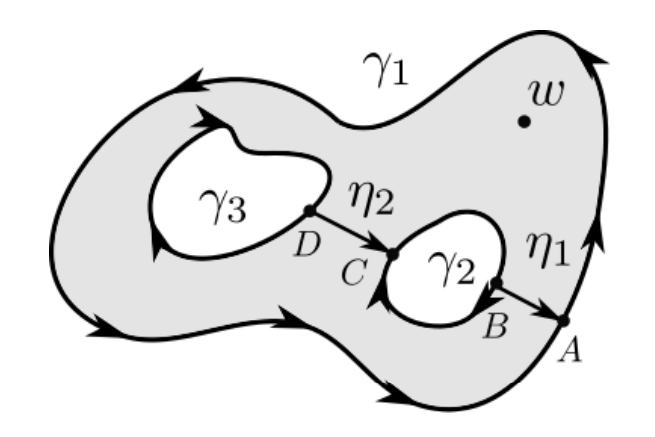
Idea of proof is to add a few cuts that avoid and connect inner boundary components to each other and to the outer boundary in such a way that without those extra curves is simply connected
Let be the boundary of the domain
Apply Cauchy’s Integral Formula to soAs curve is made up of boundary components in the right orientation and cuts
where appear twice with different orientations so the integral cancels out
3.2 Homotopy Version of Cauchy’s Theorem (Non-Examinable)
3.2.1 Cycles
Link to originalCycle
Cycle is a finite formal sum of closed paths so
where and is a closed path for each
Link to originalSupport of a Cycle
Let be a cycle
Suppose of is defined as
Link to originalIntegral of a Cycle
Let be a cycle then
For any piecewise function defined on the integral over is defined as
Link to originalWinding Number of a Cycle
Let be a cycle then
Link to originalInside of a Cycle
Let be a cycle then
Link to originalLength of a Cycle
Let be a cycle then
Link to originalRemoval of a Point in a Cycle lemma
Let be a cycle in a domain
Suppose then
There exists cycle such that andfor every holomorphic function
Proof
Use induction on where is the smallest integer such that can be in form
Assuming that for all cycles with then
If then let
Let be a cycle such thatfor all holomorphic functions defined on
Let
If for all then let
Otherwise there exists with so shift parametrisation to getLet such that and
Since is compact then is uniformly continuousHence there exists such that if then
Hence if image of interval contains then
Let be the partition of
By taking to beSuppose for some then
So by Path Deformation Away from a Point
with and then replace it with path inAs alteration to the path on each interval gives a path which doesn’t pass through
Then by Cauchy’s Theorem for Simply Connected Domains for the disk thenHence define
gives the required cycle
Link to originalPath Deformation Away from a Point lemma
If be a piece-wise path
where image is contained in open ball andThen
There exists path with
Proof
By translation and scaling assume that and
If necessary replace with (Opposite path) so that
If for all then let
Otherwise there exists with so that for
Then
Hence
As is continuous then
If given by
Let and then
where is continuous and for all
3.2.2 The Homology Form of Cauchy’s Theorem
11 - Homology Form of Cauchy's Theorem
Link to originalHomology Form of Cauchy's Theorem
Let be a holomorphic function
Let be a cycle in whose inside lies entirely in so for allThen Cauchy’s Theorem and Integral Formula hold so
1)
Proof
Let
For fixed define by
By Cauchy integral formula for the winding number then
By General Cauchy integral formula for the winding number then
Both and are holomorphic for all so is holomorphic onFor fixed then is also clearly a holomorphic function of on and as
Then it extends to a continuous function on which also denote by where
Since it is continuous at then is bounded near
By Riemann’s Removable Singularities Theorem then
Extension is holomorphic as a function of on all ofBut extending the definition of from to all of by setting
If then since is holomorphic then by Removal of a point in a cycle
There is a cycle not containing such thatSo replacing by and applying the same reasoning then is holomorphic on
Most importantly it is holomorphic atSince is arbitrary then is holomorphic on all of
Let
Since is holomorphic on all of , it restricts to holomorphic function on
By assumption henceMoreover if then but is neither inside or on so by definition
So by defining
with being a well-defined entire function
Clearly on if on
But for large so
By General cauchy integral formula for the winding number thenHence defines a bounded entire function which is constant so is by Liouville’s Theorem
3.3 Applications of the Integral Formula
Link to originalTaylor Series for Holomorphic Functions corollary
Let be a function
If is holomorphic on open set then for any then
and the Taylor Series converges on any open disk centred at lying in
Derivatives of at are given by
for any where is such that
Note that the integral formulae for the derivatives of are also referred to as Cauchy’s Integral Formulae
Follows from
Link to originalAnalytic
Let be an open subset of
If is a function on then
is analytic on if for every there is with such that
There exists power seriesand
Note that an analytic function is holomorphic
Link to originalEntire
Function is entire if it is complex diffferentiable on the whole complex plane
![[12 - Liouville's Theorem]]
13 - Fundamental Theorem of Algebra
Link to originalFundamental Theorem of Algebra
Suppose that
is a non-constant polynomial where and then
Proof
By rescaling then assume that
If for all then
since is entire
Claim that is bounded
Since is continuous then it is bounded on any disc so need to showIn other words
However
As as then for sufficiently large so for
So for then so as as then
So is bounded and hence constant so is constant which is contradiction
14 - Morera's Theorem
Link to originalMorera's Theorem
Suppose that is a continuous function on an open subset
If for any closed path where then
Proof
By Existence of Primitives Theorem then has primitive
But as is holomorphic on then it is infinitely differentiable on so
Link to originalUniform Convergence on Compacts
Let be an open subset of
If is a sequence of functions defined on then
uniformly on compacts if
For every compact subset of then sequence converges uniformly toNote that is continuous if are also continuous
Link to originalHolomorphic of Uniform Convergence on Compacts
Suppose that is a domain
Let sequence of holomorphic functions
Suppose converges to uniformly on compacts in thenProof
Since is open, for any there exists such that
As is convex then by Cauchy’s Theorem for Simply Connected Domains then
For every closed path whose image lies in thenBut as is a compact subset of then uniformly on so
Hence integral of around any closed path in is zero
So by Morera’s Theorem then is holomorphic
3.4 The Identity Theorem
Link to originalZeros of Holomorphic Functions
Let be an open set
Suppose that is holomorphic onLet
If then either is isolated in or on a neighbourhood of
If is isolated in then there is unique integer and holomorphic function such thatwhere and is the multiplicity of zero of at
Also known as order of vanishingProof
Pick any with
Since is analytic at there is such that then
where coefficients are given by Taylor series for holomorphic functions
If for all then for all
Otherwise let
As then soLet
So holomorphic on andHence
Hence is holomorphic on all of
Since is continuous at and there exists such that
However vanishes only at hence
so is isolated
In order to show is unique
Supposewith and
If then
Hence as then which contradicts assumption that
So by symmetry then so
15 - Identity Theorem
Link to originalIdentity Theorem
Let be a domain
Suppose are holomorphic functions defined onIf has a limit point in then
In other words
Proof
Let so
Since is clearly holomorphic in then by Zeros of holomorphic functions then
If then either is an isolated point of or it lies in an open ball contained inSo
where and
As is continuous then is closed in thus is closed
So which is the closure of in lies inHowever by definition, no limit point of can lie in so
Hence is open and closed in so as is connected then orIf then all zeros of are isolated so has no limit points
If then
3.5 Isolated Singularities
Link to originalSingular Point
Let be a function where is open
If is not holomorphic at then
Link to originalIsolated Singularity
Let be a function where is open
If is holomorphic on for some then
Link to originalMeromorphic
Let be a function where is open
is a meromorphic function on if
Link to originalTypes of Isolated Singularities
Let be a function where is open
Let be an isolated singularity of function then
- Removable Singularity - Exists function holomorphic in with such that
- Pole of Order - Exists function holomorphic in with such that
- Essential Singularity - Otherwise
16 - Laurent's Theorem
Link to originalLaurent's Theorem
Suppose and
where is an annulus centred at
If is holomorphic on an open set which contains then exists such that
Series is known as the Laurent Series of and
Converges for all
Converges uniformly for all where
Moreover is unique and given by
where and for any then
Proof
By Cauchy formula for multiple curves for any then
Note that both boundary components are counter-clockwise oriented
However in Cauchy formula for multiple curves, inner component is clockwise oriented
So it is compensated by the minus sign in front of second integralFixing then for then
and for then series converges uniformly for any thus
for all
Similarly for then
which again converges uniformly when for then
Thus by taking to be the statement in the theorem then
as required
Link to originalLaurent Series in a Punctured Disc corollary
If is a holomorphic function and is an isolated singularity then
for any such that
Proof
Let be such that and apply Laurent’s Theorem to
As the coefficients can be written in terms of integrals along thenBy sending to zero then Laurent Series converges in
and converges uniformly in for any
Link to originalPrincipal Part of the Laurent's Series
Let be an isolated singularity of with Laurent’s Expansion
Principal Part of at is the sum of terms with negative powers denoted by
Link to originalResidue
Let be an isolated singularity of then
Residue of at is defined as the coefficient of of the Lareunt Expansion denoted by
Reason for such Definition
Consider function given by series
which converges uniformly in an annulus containing then integrate term by termFor then has a well defined primitive so integrate to on
However for then the integral of along is so
17 - Characterisation of Isolated Singularities
Link to originalCharacterisation of Isolated Singularities
Let be an isolated singularity of
Let be the Laurent Expansion of thenis classified as
Removable Singularity: If for all
Pole of Order : If and for all
Essential Singularity: There is arbitrary large such that
Equivalent Statements for Principal
Principal Part vanishes
Principal Part is non-trivial but contains a finite number of non-zero terms
Principal Part contains infinitely many non-zero terms
Proof
If there is no principal part then has a ordinary power series for it’s Laurent Expansion
would converge to function which is analytic in some disc around
where for all so is removableIf is removable then there is function which is holomorphic at
with coinciding with in
Hence Laurent Expansion coefficients are equal, but for holomorphic function then
All coefficients with are given by integrals of holomorphic function
However by Cauchy’s Theorem for Simply Connected Domains then integrals vanishIf Laurent Expansion is in form
with then where
which is analytic in some neighbourhood of
If is a pole of order then there is holomorphic such that
Writing the Taylor Series of then the Laurent Expansion of is in form
where the last part follows trivially from the last two
18 - Riemann's Removable Singularity Theorem
Link to originalRiemann's Removable Singularity Theorem
Suppose is an open subset of and
Suppose is holomorphic thenis a removable singularity if and only if is bounded near
Proof
Proof
If is removable then there is holomorphic such that on for
So as so is boundedProof
Assume that is bounded and define byso is holomorphic on using is complex differentiable
If thenas since is bounded near by assumption
So is holomorphic everywhere in
However for such that so by Taylor series for holomorphic functions
Then it is equal to its Taylor Series centred at thusSince then hence
defines a holomorphic function in
Since it agrees with on then extend to holomorphic function on
Link to originalPoles and Zeroes of Reciprocal lemma
Let be a holomorphic function in a neighbourhood of then
is a pole if and only if as
In this case function
is holomorphic on neighbourhood of , multiplicity of zero at is equal to order of pole of
Proof
Assume has pole of order so by Characterisation of Isolated Singularities then
has a Laurent Expansion ofwhich can be rewritten as
where the series converges to a function analytic at denoted by then
Since then function is holomorphic in neighbourhood of and
Thus has a removable singularity and after removing has a zero multiplicity of
Assume then
so by Characterisation of Isolated Singularities then
It can be extended to holomorphic function with atAs the must be of finite order so then
where is holomorphic with then
so has a pole of order
19 - Casorati-Weierstrass or Weierstrass Theorem
Link to originalCasorati-Weierstrass or Weierstrass Theorem
Let be an open subset of
LetSuppose is a holomorphic function with isolated essential singularity at then
For all with then
In other words the closure of is all of
Proof
Suppose for contradiction that there is some such that
Then function
is bounded and non-vanishing on
Hence by Riemann’s Removable Singularity Theorem then
can be extended to a holomorphic function on all ofBut then
has at most a pole at which is a contradiction
20 - Residue Theorem
Link to originalResidue Theorem
Suppose that is an open set in
Suppose is a closed curve that is contained in together with its insideSuppose is holomorphic on where is a finite set of isolated singularities of
Assume that has no singularity on so that then
Proof
For each let
where is the principal part of at so is a holomorphic function on
By definition of then difference is holomorphic at thus
is holomorphic on all of
By Homotopy Cauchy’s Theorem as contains and it’s inside then is null homotopic
Hence
By Convergence of the principal part then series converges uniformly on so
as for then function has a primitive on
3.6 The Argument Principle
Link to originalResidue of the Logarithmic Derivative lemma
Suppose is meromorphic and has zero of order or pole of order at then
Proof
If has a zero of order then
where is holomorphic near and then
since near then is holomorphic near so result follows
Case is similar where has pole at
21 - Argument Principle
Link to originalArgument Principle
Suppose is meromorphic on
Let be simply positively oriented contour such that and it’s inside is contained inAssume has no zeroes or poles on
Let is the number of zeros (counted with multiplicity) of inside
Let be the number of poles (counted with multiplicity) of inside thenMoreover it is also the winding number of path about the origin
Proof
Curve is simple so winding number around any point inside is
By Residue of the logarithmic derivative then
has simple poles at zeros and poles of with residues given by their order
So result follows from Residue TheoremFor the last part then
22 - Rouché's Theorem
Link to originalRouché's Theorem
Suppose and are holomorphic functions on an open set in
Let be a simple contour that is contained inside of together with it’s interiorIf for all then
have the same change in argument around
Hence they have the same number of s (counted with multiplicity) inside of
Proof
Consider function
then the zeros of are zeros of and poles are zeros of
Note that the assumption implies that has no zeroes or poles on
By the argument principle then
Difference between number of zeroes and poles is equal to winding number ofBy assumption for then so
Hence image of lies entirely in and thus lies in half plane
So picking the principal branch of defined on the half plane then integral
23 - Open Mapping Theorem
Link to originalOpen Mapping Theorem
Suppose is holomorphic and non-constant on a domain then
For any open set then set is also open
Proof
Suppose
Consider such that so
Let such that it has a zero atSince is non-constant then the zero is isolated
Thus there exists some such that has no other zeros inside
Since is compact then there is such that
Consider any such that then
Hence by Rouché’s Theorem then
have the same number of zeros (counting multiplicities) inside
Since has a zero at of multiplicity of at least one then
Equation has at least one solution insideThus
and is open
24 - Inverse Function Theorem
Link to originalInverse Function Theorem
Suppose is injective and holomorphic and for all
If is the inverse of then is holomorphic with
Proof
By the Open Mapping Theorem| then is continuous and
If is open in then is open by the theoremFix
Let then since and are continuous thenThus
3.7 Applications of the Residue Theorem
Link to originalResidue of a Simple Positively Oriented Contour
Let be a simple positively oriented contour
Let be holomorphic on and inside of except at a finite set of isolated singularities
where none of the singularities lie on itself then
3.7.1 On the Computation of Residue
Link to originalResidue of Poles
Suppose has a pole of order at then
Residue of Poles for Ratios is a ratio of two holomorphic functions defined on domain where is non-constant then
Suppose
is meromorphic with poles at zeros of
If has a simple zero at and is non-vanishing then has a simple pole at
Since the zero of is simple at then henceProof
Since has a pole of order at then
where is sufficiently close to hence
where the result follows from the formula derivatives of a power series
3.7.2 Residue Calculus
Link to originalBoundary of Half-Disk Contour Integral
Suppose we want to find integral of
Define contour as the concatenation of paths and where
such that traces boundary of half-disk
In many cases it can be shown that
So by calculating the residues inside contour then the
Integral of on can be deduced
3.7.3 Jordan’s Lemma and Applications
Link to originalConcavity of a Function lemma
Let be a differentiable function then
If is an interval where then function is concave on if
For all then
In other words the chords between any two points on the graph lies below the graph itself
Proof
For and
Let be a point in interval between
Slope of chord between and by MVT is equal to
whilst slope of chord between and is equal to
If then
So by MVT for applied to and then exists with
which contradicts assumption that is negative on
Link to originalJordon's Lemma lemma
let be a continuous function on where
Then for all positive
In particular, suppose is holomorphic on where
and be the finite set of isolated singularities
Suppose as in then
Proof
Apply Concavity of a function to function with and
Soand similarly
Thus
But then
Fix
Since as then as is finite
There exists such that for all hence
Link to originalResidue from Small Circle Integrals lemma
Let be a meromorphic function with a simple pole at
Let be path defined bythen
Proof
Since has a simple pole at then
where is holomorphic near and
Note that is the principal part of at
As is holomorphic at then it is continuous at and hence bounded
Let such thatThen if then
which tends to as
However also
Since
then result follows
3.7.4 Summation of Infinite Series
Link to originalContour Bound for
Let
Let denote the square path with vertices
Then there is constant independent of such that
Proof
Consider horizontal and vertical sides of square separately
Note
So on horizontal sides of where for
As is a decreasing function for then on horizontal sides of then
On vertical sides then where
As for any integer and thenIf for any then
So set
3.7.5 Keyhole Contours
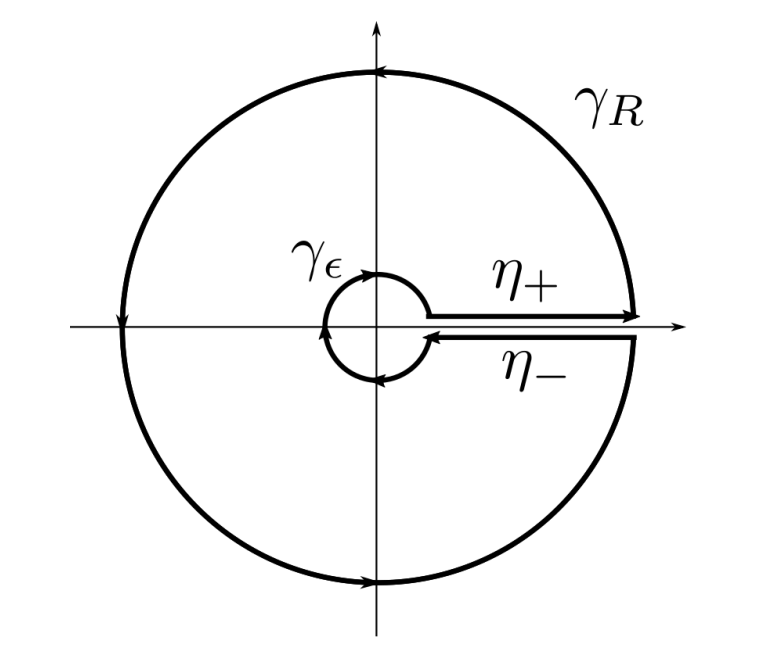
Link to originalKeyhole Contours
Constructed from two circular paths of radius and
where becomes arbitrarily large and arbitrarily smallJoin the two circles by line segments with narrow neck in between
Explicitly if then pick withwhere runs over closed interval with endpoints such that
Endpoints of lie on circles of radius and radius about originLetting be positively oriented path on circle of radius joining endpoints of and on circle of radius
Similarly let be path on circle of radius which is negatively oriented and joining endpoints of and on circle of radius
Set