Residue
Let be an isolated singularity of then
Residue of at is defined as the coefficient of of the Lareunt Expansion denoted by
Reason for such Definition
Consider function given by series
which converges uniformly in an annulus containing then integrate term by termFor then has a well defined primitive so integrate to on
However for then the integral of along is so
Residue of the Logarithmic Derivative lemma
Suppose is meromorphic and has zero of order or pole of order at then
Proof
If has a zero of order then
where is holomorphic near and then
since near then is holomorphic near so result follows
Case is similar where has pole at
Residue of a Simple Positively Oriented Contour
Let be a simple positively oriented contour
Let be holomorphic on and inside of except at a finite set of isolated singularities
where none of the singularities lie on itself then
Residue of Poles
Suppose has a pole of order at then
Residue of Poles for Ratios is a ratio of two holomorphic functions defined on domain where is non-constant then
Suppose
is meromorphic with poles at zeros of
If has a simple zero at and is non-vanishing then has a simple pole at
Since the zero of is simple at then henceProof
Since has a pole of order at then
where is sufficiently close to hence
where the result follows from the formula derivatives of a power series
Boundary of Half-Disk Contour Integral
Suppose we want to find integral of
Define contour as the concatenation of paths and where
such that traces boundary of half-disk
In many cases it can be shown that
So by calculating the residues inside contour then the
Integral of on can be deduced
Residue from Small Circle Integrals lemma
Let be a meromorphic function with a simple pole at
Let be path defined bythen
Proof
Since has a simple pole at then
where is holomorphic near and
Note that is the principal part of at
As is holomorphic at then it is continuous at and hence bounded
Let such thatThen if then
which tends to as
However also
Since
then result follows
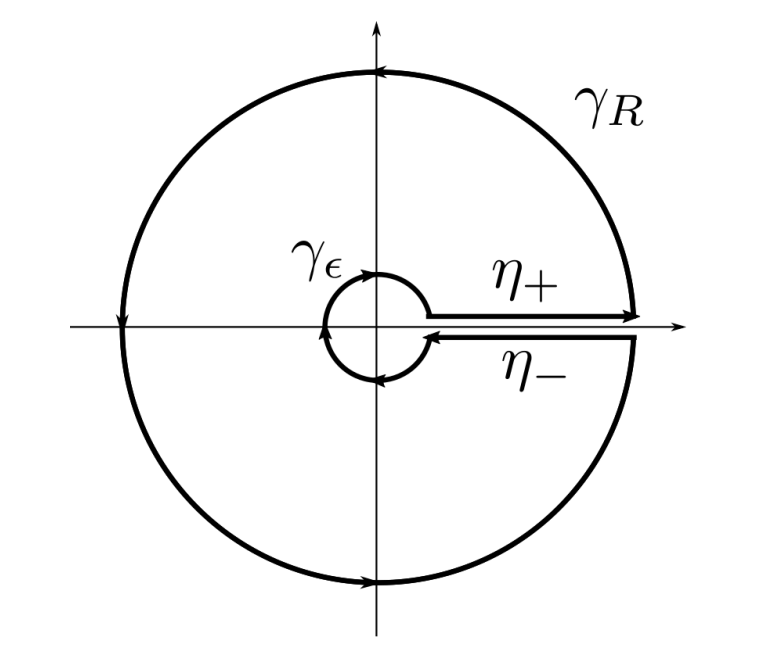
Keyhole Contours
Constructed from two circular paths of radius and
where becomes arbitrarily large and arbitrarily smallJoin the two circles by line segments with narrow neck in between
Explicitly if then pick withwhere runs over closed interval with endpoints such that
Endpoints of lie on circles of radius and radius about originLetting be positively oriented path on circle of radius joining endpoints of and on circle of radius
Similarly let be path on circle of radius which is negatively oriented and joining endpoints of and on circle of radius
Set