7.1 Representing linear maps with matrices
Link to originalMatrix for with respect to bases and
Let be a -dimensional vector space over with an ordered basis of vectors
Let be a -dimensional vector space over with an ordered basis of vectors
Hence every vector in and is represented by a coordinate vector in andLet be a linear transformation
The matrix for with respect to the bases and is the matrix that takes the coordinate vector of to the coordinate vector ofIn other words this is the matrix where
This is written as for this matrix
Refer to the example below to get a better understanding!
Note about the property of the matrix then can be uniquely expressed as a linear combination of
It is well defined and for each
Specifically, are the coordinates of
These are the entries in the th column of
The coordinate column vector of is and the th column of is
So the entries of are the coordinates of the image of the basis
Link to originalOrder of the vectors in the basis is very crucial, if the order changes so does the matrix
Link to originalMatrix for with respect to this basis
Same as above but with
So we use the same ordered basis for both the domain and codomain of
Link to originalFinding Matrix with respect to a basis (1)
Link to originalZero Map Matrix
Let be a -dimensional vector space over with ordered basis
Let be a m-dimensional vector space over with ordered basisLet be the matrix represented by the zero map
Then
Link to originalIdentity Map Matrix
Let be a -dimensional vector space over with ordered basis
Let be the matrix represented by the identity map
Then
Link to originalLinear Property of a Linear Map Matrix
Let be a -dimensional vector space over with ordered basis
Let be a m-dimensional vector space over with ordered basisIf are linear and for then
08 - Matrix Representation of a Composition of Linear Maps
Link to originalMatrix Representation of a Composition of Linear Maps
Let be finite-dimensional vector spaces over of dimensions with ordered basis respectively
Let and be linearLet
Then
Illegal way to think but the middle vector space () “cancels out” ;(
Proof
Note that is a matrix and is a matrix hence is a matrix
Let be
Let be
Let beSuppose that and then by definition
Then for we have
Hence by definition
Link to originalAssociative Property of Matrices through Linear Maps corollary
Take , take , and take
ThenProof
Consider the left multiplication maps
With respect to the standard bases of these spaces, then represent the matrices of as respectively
Then
By Matrix of a Composition of Linear Maps, and are matrices ofBut composition of functions is associative, so
Hence
Link to originalInvertible Linear Maps and Matrices corollary
Let be a finite-dimensional vector space
Let be an invertible linear transformation
Let be a matrix of with respect to an ordered basis (for both domain and codomain)Then is invertible, and is the matrix of with respect to the same basis
7.2 Change of basis
09 - Change of Basis Theorem
Change of Basis Theorem
Let be a finite-dimensional vector space over with ordered
Let be a finite-dimensional vector space over with ordered basesLet be a linear map
ThenFollows from 08 - Matrix Representation of a Composition of Linear Maps =_=
Link to originalChange of Basis Theorem V2
Let be a finite-dimensional vector space over with ordered basis
Let be a linear map
ThenIf we set
ThenSpecial case from the proof above :)
Link to originalSimilar Matrices
Take
If there is an invertible matrix such that thenIt is also an equivalence relation
Link to originalProperties of Linear Maps
Let and be matrices represented with respect to two bases so that
- is invertible if and only if invertible
- Trace of equals the trace of (follows from identity )
- A functional identity satisfied by , such as , is also satisfied by
- Determinant of equals the determinant of
- Eigenvalues of equals the eigenvalues of
Note that and will be formally defined in Linear Algebra II
7.3 Matrices and Rank
Link to originalRelation between and
From the definitions then so
Similarly
so
Link to originalConsistent Linear System lemma
Proof
Suppose that is a matrix and denote the columns of as
Then
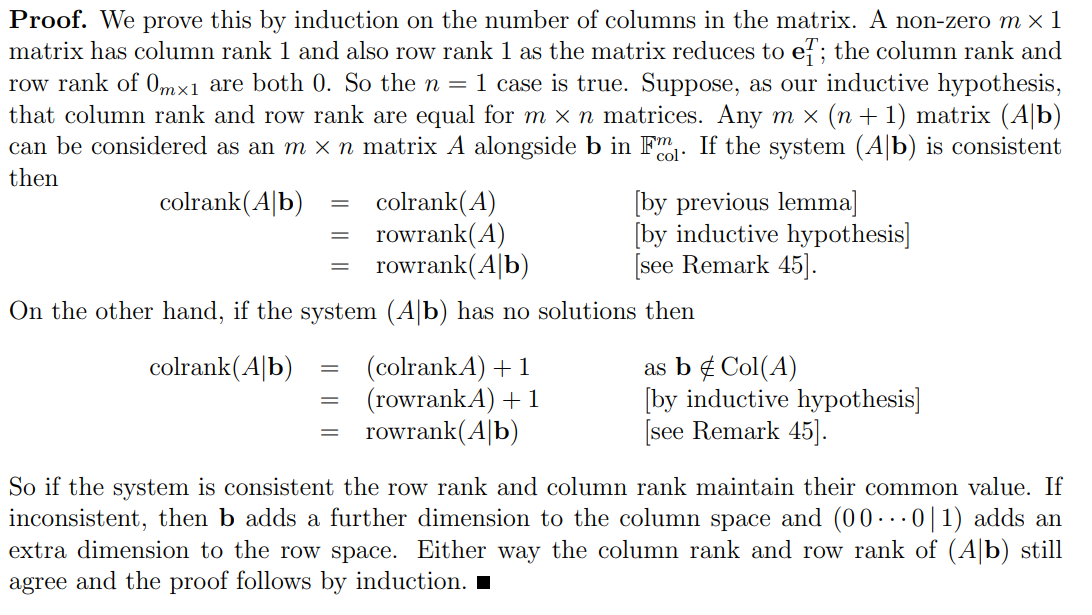
10 - Column Rank equals Row Rank
2> [!definition] Column Rank equals Row Rank
Link to originalThe column rank of a matrix equals its row rank
Proof
11 - Row Rank Criterion on Product of Matrices
Link to originalRow Rank Criterion on Product of Matrices
Let where are respectively matrices over
is at most
Let , then can be written as a and matrix
The row rank and column rank of a matrix is equal
Proof
- By Property of Row Space we have
Hence
- There is a invertible matrix such that and hence
Let denote the first columns of and denote the first rows of
As the last rows of are zero rows thenwhere is a and is a matrix
3) From and , the row rank of a matrix is the minimal value such that
can be written as the product of a matrix and a matrix
WheneverSo the row rank of is similarly . But the as required