Motivation for Bessel's Equation
Arises from separation of variables in Laplacian in Cylindrical Polar Coordinates
Consider vibrating membrane of circular drum
Transverse Displacement of membrane at and position satisfies
Two-Dimensional Wave Equationwhere is a constant
If membrane is pinned at boundary of disk of radius for then for
Look for a normal mode where membrane oscillates with frequency
Hence displacement is in formBy substitution then satisfies Helmholtz Equation
where
Switching to plane polar coordinates such that
Hence through substitutionHence it is a PDE Eigenvalue Problem
As satisfies equation then need to find with non-trivial solutions
Since is periodic in , expand into Fourier Series of FormSubstituting Fourier Series into PDE then
where the same equation and boundary condition hold for
Let where then
where it is Bessel’s Equation of Order
Bessel's Equation of Order
Note that it arises from separation of variables in Laplacian in Cylindrical Polar Coordinates
Properties of Bessel's Equation
Regular Singular Point at with indicial equation
with solutions
One solution is given by Frobenius Series about with indicial exponent
Second solution is given by Frobenius Series with exponent plus times first sol
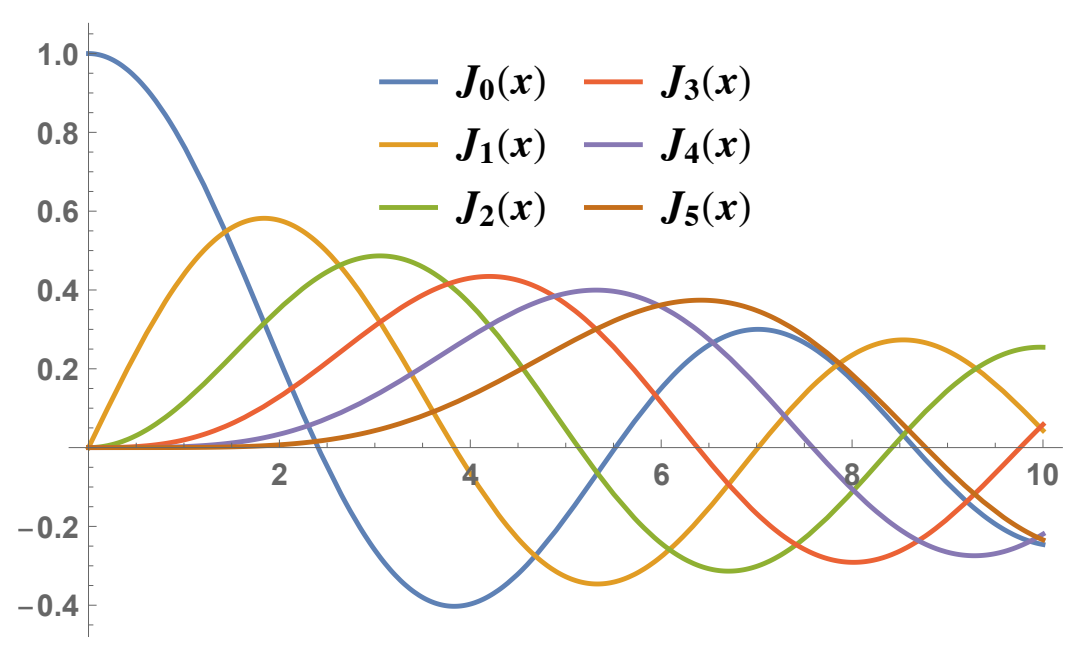
Bessel Functions of First Kind
First Frobenius Series, with specific normalising of the leading coefficient in the expansion
for integer
Graph
Bessel Functions of Second Kind
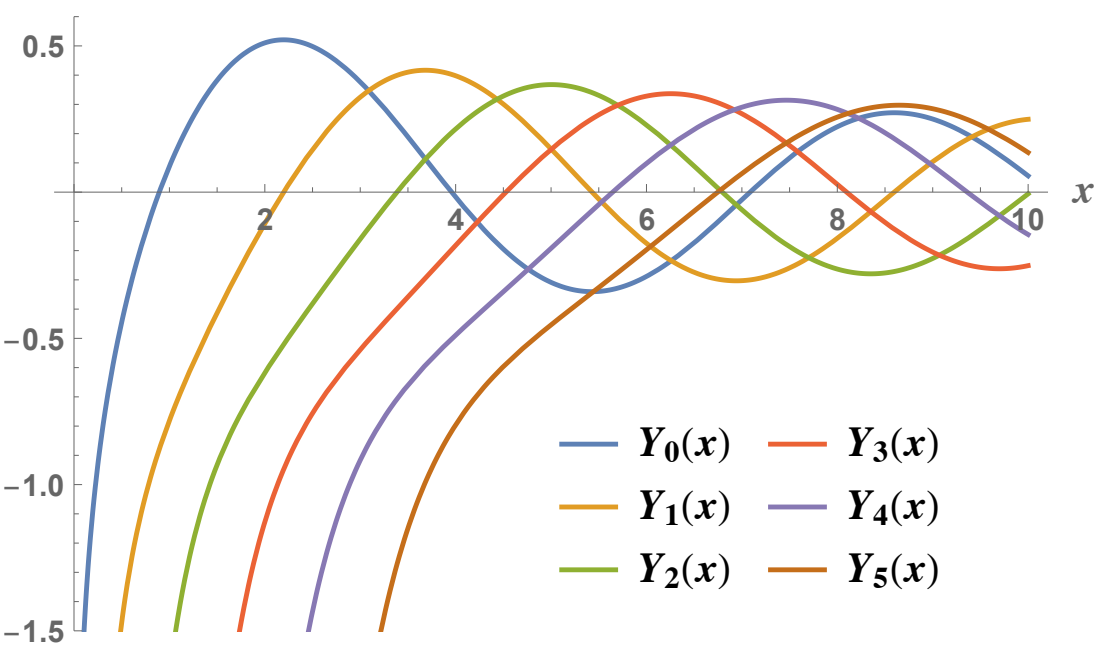
Second Frobenius Series, also with specific normalising of the leading coefficient
where diagamma function for integer is defined by
and is the Euler-Mascheroni Constant
Graph
Properties of Bessel Functions
- Bessel’s Equation only has one singular point for finite so
and are oscillating functions decaying slowly as
Each has an infinite set of discrete zeros inAs , behaviours of the two kinds of Bessel Function are quite different
For first kind then if and
Whilst second kind Bessel functions are singular with asTwo recursion relations can be derived
Same relations hold for second-kind Bessel functions
Zeroes of Bessel Functions of the First Kind
1 2.40483 3.83171 5.13562 6.38016 7.58834 2 5.52008 7.01559 8.41724 9.76102 11.0647 3 8.65373 10.1735 11.6198 13.0152 14.3725 4 11.7915 13.3237 14.796 16.2235 17.616 5 14.9309 16.4706 17.9598 19.4094 20.8269 First five zeros of with
Zeroes of Bessel Functions of the Second Kind
|||||||
| --- | -------- | ------- | ------- | ------- | ------- |
| 1 | 0.893577 | 2.19714 | 3.38424 | 4.52702 | 5.64515 |
| 2 | 3.95768 | 5.42968 | 6.79381 | 8.09755 | 9.36162 |
| 3 | 7.08605 | 8.59601 | 10.0235 | 11.3965 | 12.7301 |
| 4 | 10.2223 | 11.7492 | 13.21 | 14.6231 | 15.9996 |
| 5 | 13.3611 | 14.8974 | 16.379 | 17.8185 | 19.2244 |First five zeros of with
General Solution of Polar ODE
Let ODE be
from the motivation of Bessel’s Equation of Order
Then it has general solution
for some arbitrary constants and
As displacement must be bounded as , hence to remove singularity in
As is non-trivial then so boundary conditions leads toHence has to be one of the zeroes of of
Hence eigenvalues are given by
with corresponding eigenfunctions
Sturm-Liouville Form of Polar ODE
Let ODE be
from the motivation of Bessel’s Equation of Order
Multiplying by and on disk of unit radius then
Hence it has eigenvalues and eigenfunctions
As it is a singular Sturm-Liouville equation with weighting function then
For then