4.1 Classification
Link to originalSecond Order Semi-Linear PDEs
PDE is linear if is linear in otherwise is semi-linear
PDE is quasi-linear if also depend on
4.1.1 The Idea
Link to originalIdea of Solving Them
Using Second Order Semi-Linear PDE Form then
Want to have a change of variables
with non-vanishing Jacobian (so the map is locally invertible) that is
Link to originalClassification Form of Second Order Semi-Linear PDEs
For Second Order Semi-Linear PDE Form
then we have equation
where
Proof
Using the change of variables
then the first partial derviatives are
So then the second partial derivatives are
Hence the PDE becomes
where
for some which will include lower order derivatives from the second partial derivatives
Writing in a matrix notation we get
So by taking determinants then
4.1.2 The Classification
Link to originalClassifying Second-Order Linear PDEs
From Classification Form of Second Order Semi-Linear PDEs
We have three types
- Hyperbolic: (e.g. Wave Equation)
- Elliptic: (e.g. Laplace Equation)
- Parabolic: (e.g. Heat Equation)
So the class of the equation is invariant under transformations with non-vanishing Jacobian
Note that the type can change depending on value of etcProof
Look at classification in terms of the quadratic polynomial
Assuming that in the domain under consideration
If and then swap the roles of andCase 1: Hyperbolic Type so quadratic has distinct roots so we have characteristic equation
So
is equivalent to
Suppose respectively the equations have solutions which are characteristic curves
Hence we can use those as a change of variables so we get characteristic variables
Then on then
So
Thus
So similarly
As so so
Hence we get the equation in formWhich is the normal / canonical form for a hyperbolic equation
Case 2: Elliptic
We have so characteristic equation
has a complex conjugate pair of roots, and the integral curves of
are in conjugate complex pairs where
These complex coordinates then we get and so the equation becomes
By introducing new variables given by and
Get normal form of an elliptic equationNote that this closely resembles Laplace’s Equation
Case 3: Parabolic
We have so we have repeated root
By solving we get coordinate and then pick such that
to get the second coordinate
So similarly we get so with
As is not a characteristic curve thenwhich is the normal form for a parabolic equation
4.2 Characteristics
Link to originalCharacteristics of Second Order Semi-Linear PDEs
Analogous Properties to the Characteristic Projections of First Order Semi-Linear PDEs
Link to originalDiscontinuities in Second Derivatives
Discontinuities in Second Derivatives of a solution across a given curve means
Proof
Suppose curve defined parametrically by
is a curve across which there are discontinuities in the second derivative of solution
Let denote values on one side of and denoting values on the other side of
Differentiating and along
\begin{alignat*}{3} \frac{du_{x}}{ds} &= \quad && \frac{dx}{ds}u_{x x}^\pm + \quad && \frac{dy}{ds} u_{xy}^\pm \\ \frac{du_{y}}{ds} &= && && \frac{dx}{ds}u_{y x}^\pm + \quad && \frac{dy}{ds} u_{y y}^\pm \\ \end{alignat*}
with being continuous across the curve thenwith
Subtracting the minus equation from the plus equations we get
\begin{alignat*}{3} 0 &= \quad && \frac{dx}{ds}[u_{x x}]^+_{-} + \quad && \frac{dy}{ds} [u_{xy}]^+_{-} \\ 0 &= && && \frac{dx}{ds}[u_{y x}]^+_{-} + \quad && \frac{dy}{ds} [u_{y y}]^+_{-} \\ 0 &= &&a(x, y)[u_{x x}]^+_{-} + &&2b(x, y)[u_{x y}]^+_{-} + &&c(x, y) [u_{yy}]^+_{-} \end{alignat*}where denotes the jump in across , etc
If there are discontinuities in the second derivatives then
the set of equations in the jumps must have a non-zero solution henceHence is a characteristic
4.3 Type and Data: Well Posed Problems
Link to originalWell Posed PDE
Problem consisting of a PDE with data is well posed if solution
- exists
- is unique
- depends continuously on data
Link to originalSolution Depends Continuously on Data
Let be a solution of a PDE in a bounded subset of plane with given on curve
Solution depends continuously on data if
such that if are solutions with on then
Link to originalModels from Prelims
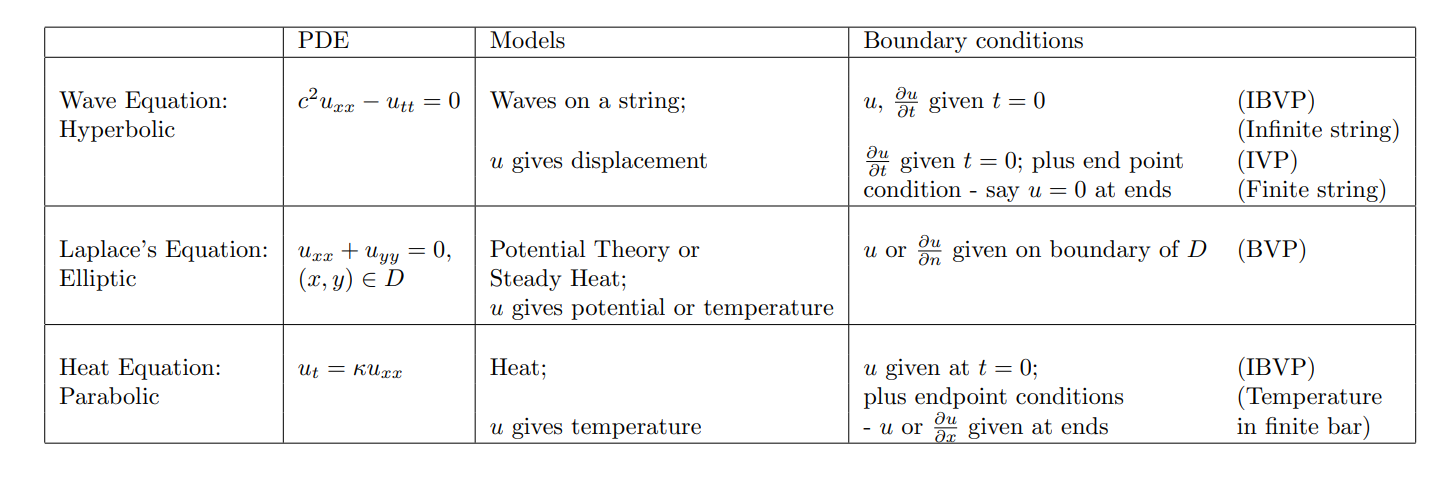
4.4 The Maximum Principle
4.4.1 Poisson’s Equation
Link to originalNormal form for Second Order Elliptic PDE
07 - The Maximum Principle for the Laplacian
Link to originalThe Maximum Principle for the Laplacian
Suppose satisfies
everywhere within a bounded domain then
If on then attain minimum value on (substitute with )
If then attains both maximum and minimum values onProof
Denote boundary of as so is a closed boundary set so compact
Hence must attain the maximum either on or on the boundarySuppose that in
If has an interior maximum at some point inside then we have the followingAs we assumed that in all od then there is a contradiction
Hence cannot have an interior maximum within so it must attain it on boundarySuppose now we have in
Considerfor some positive constant
Then
which is in , so attains maximum value on
So suppose now that
- maximum value of on is
- maximum value of on is
then maximum value of on (and throughout ) is
In other words we have
holding for all
Then if we have that throughout hence attains maximum value on
Link to originalProperties of Dirichlet Problem corollary
For Dirichlet Problem for with boundary of
then
If the solution exists it is unique
Solution has continuous dependence on data
Proof
- Suppose that are two solutions so satisfies
So by The Maximum Principle for the Laplacian then
the maximum and minimum of occur on hence and on so
- Need to prove that for all there exists such that if
then
By linearity satisfie
Using maximum principle we get that
So applying same result to we get
Hence in
so take
4.4.2 The Heat Equation
Link to originalNormal Form for Second Order Parabolic PD
08 - The Maximum Principle for the Heat Equation
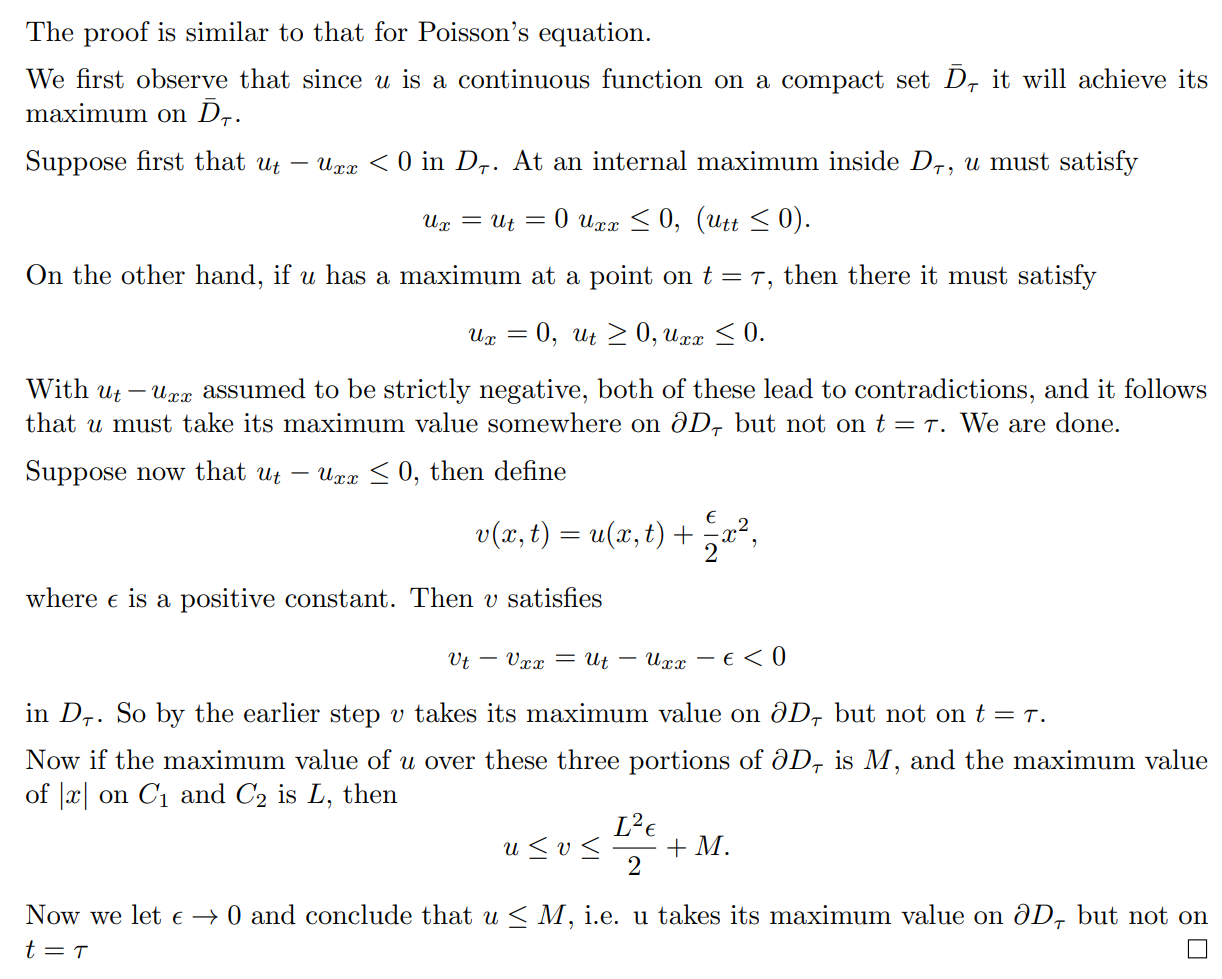
Link to originalThe Maximum Principle for the Heat Equation
Suppose satisfies
in a region bounded by
- lines and
- two non-intersecting smooth curves and which are nowhere parallel to axis
Suppose also that in then
takes maximum value either on or on one of the curves or
If then attains minimum value on but not on
Proof
Link to originalProperty of Heat Problem
Consider IBVP
where satisfies
in a region bounded by
- lines and
- two non-intersecting smooth curves and which are nowhere parallel to axis
with given then